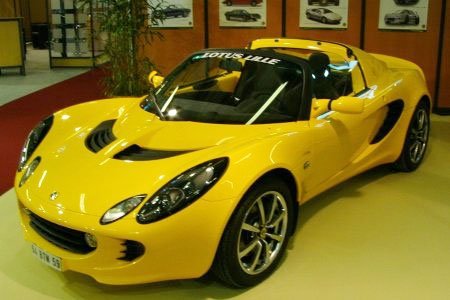
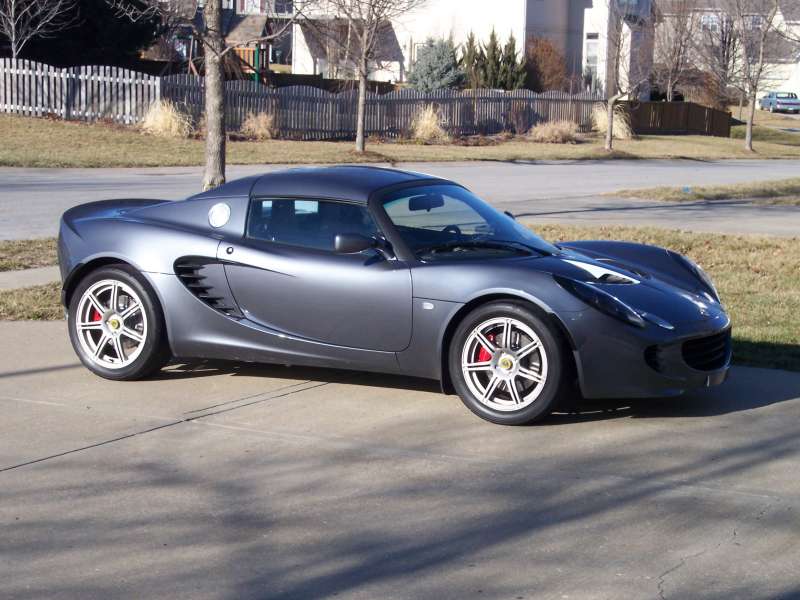
Anyone harbouring under the misapprehension that Lotus might be moving away from performance through lightweight only needs to take a quick ride in the new 1.6 Lotus Elise Club Racer to know that's definitely not the case. The bright engineers at Lotus put even the lightest of Lotus' modern cars on a diet and managed to shed a further 24kg.
So how did Lotus manage to make one of the lightest models on the market even lighter? The engineers behind the Lotus Elise Club Racer took a stripped-to-the-bare-bone approach visualised by the body-coloured seats but materialised in many ways such as the motorsport derived lightweight battery and the deletion of noise insulation. Attention to even the smallest of details has ensured that Lotus' passion for performance through lightweight has been translated throughout the car.
For the first time ever an Elise variant comes complete with a Sport setting for the DPM (Dynamic Performance Management) allowing even the less experienced sports car drivers to feel at the top of their game, while the ability to switch it off completely will please the more established track orientated drivers. DPM combined with improved agility courtesy of Lotus finely tuned sport suspension and an adjustable anti-roll bar will make the Lotus Elise Club Racer equally versatile for both road and race track fun.
Wolf Zimmermann Chief Technical Officer Lotus Cars said: "The traditional Lotus approach of reduction and purity has lead to one of the most zeitgeist and contemporary sports cars around. For over 15 years the Lotus Elise has become an icon in the sports car market, carving out a niche market with a dedicated following of lightweight fans. The new Club Racer will definitely give these people something extra to get their teeth stuck into. This car epitomises everything that's cool about the Elise - it's fast, raw, responsive and a huge amount of fun to drive."
Quality throughout the vehicle has been a top priority, highly regarded component suppliers such as Eibach for springs and Bilstein for dampers ensure that the Lotus Elise Club Racer is a car of substance as well as style.
The Lotus Elise Club Racer pleases the eye as well as the soul with a choice of six striking colours (Sky Blue, Saffron Yellow, Ardent Red, Aspen White, Matt Black and Carbon Grey) and bespoke design elements that emphasise the character of the car.
It's pocket pleasing too, at £27,500 / €34,450 / CHF48,900, the Lotus Elise Club Racer marks the new entry level sports car from Lotus. And with the Elise standard of just 149g CO2/km plus the weight reduction, the new Club Racer provides maximum fun without so much of the green-guilt usually associated with high performance driving.
Showing posts with label Lotus. Show all posts
Monday, September 26, 2011
Thursday, April 28, 2011
Additional changes to the 2011 model year Lotus Elise
2011 model year Lotus Elise
The new 2011 model year Elise has a number of additional changes and improvements, with the installation of a new advanced 1.6 litre Valvematic engine meeting EÚRO 5 regulations. This new engine is 200cc smaller than the outgoing Elise S model and produces similar power (136 PS, 100 kW, 134 hp at 6800 rpm) with maximum torque of 160 Nm, 118 lbft at 4400 rpm, but offers a significant improvement to fuel economy of over 23%, to 6.14 litres / 100km (46 mpg)* and a reduction in CO2 emission by more than 13%*. This provides the new Lotus Elise with the lowest CO2 per performance for any gasoline high performance sportscar in the world. This high technology engine is mated to a new 6-speed manual gearbox, providing closer and more performance orientated ratios than the outgoing 5 speed box.
The Elise has high performance AP Racing callipers at the front and Brembo callipers at the rear linked to 282 mm vented and cross-drilled cast iron discs to give excellent stopping power. The Elise comes as standard with a track tuned ABS system that is designed to be unobtrusive under normal driving conditions. This system is designed to be used on track and has a high threshold, only intervening in emergencies. The ABS system is linked to a lightweight pedal box with steel pedal arms and extruded aluminium pads. This unit also has an electronic (drive-by-wire) throttle for quick, smooth and more linear engine response. The impressive braking coupled with excellent handling gives good primary safety and the composite front crash structure and rear crash protection offers efficient secondary safety. Driver and passenger airbags and pre-tensioning seatbelt are standard on all Elise models.
The Lotus Elise introduces the new 1598 cm3, 1ZR-FAE engine, provided by Toyota. The key to this engine’s performance and efficiency is the Valvematic system (a variable valve lift mechanism), which is combined with the dual VVT-i (Variable Valve Timing-intelligent). The engine continuously controls intake valve opening/closing timing and the intake valve lift to vary the volume of the intake airflow, giving significant improvements in efficiency and fuel economy. This ensures optimal performance based on the engines operational condition, thus helping the Elise achieve both high fuel efficiency and high performance.
First of all, the maximum power output is achieved at near maximum revs (engine speed) of 6800 rpm and maximum torque (a respectable 160 Nm, 118 lb.ft) is reached at 4400 rpm. This gives a good combination of mid range pull but also encourages the driver to rev the engine to the maximum permitted engine speed of 7000 rpm (transient rev limit). Like all Elise sportscars, there are three shift up lights, on the binnacle cumulatively lighting when the driver is getting closer to the rev limiter and when all three are illuminated, they flash to indicate that the driver is almost on the rev limiter so time to change up a gear!
Friday, April 8, 2011
Lotus Evora, The best Sport Car of The Last 12 month.
The Lotus Evora was selected by Top Gear magazine and online teams as the best Sports Car of the last 12 months.
Lotus Evora: 205 g/km CO2
32.5 mpg (8.7 litres / 100 km) - Combined Cycle
22.8 mpg (12.4 litres / 100 km) - Urban Cycle
43.5 mpg (6.5 litres / 100 km) - Extra Urban Cycle
The Lotus Evora was selected by Top Gear magazine and online teams as the best Sports Car of the last 12 months.
The Top Gear Awards, now in their 10th year, searched for the most exciting and innovative sports car of this year. The awards are not only well established, but are also truly global, running across 24 international editions and Top Gear websites in the UK, US and Australia.
Conor McNicholas, Editor of BBC Top Gear magazine commented “It’s pretty, quintessentially British, fast and handles like a dream. Evora takes Lotus to a new place in terms of quality but more importantly delivers a sports car rush that puts other marques to shame.”
Dany Bahar, CEO of Group Lotus plc said, "I am delighted that the Evora has won the Top Gear award for Sports Car of the Year 2009. Top Gear is very well regarded around the world and it is a fantastic achievement for all who have worked on the Evora to win such a prestigious award.”
Dany continued, “I am particularly pleased that the Top Gear team commented on the huge improvements in quality at Lotus, confirming that the Evora is an exciting supercar that can also be used for every day driving.”
Labels:
automobile,
automotive,
Lotus,
lotus evora,
Sport Car
Friday, February 11, 2011
Lotus Elise Review
While two-seat sports cars have become more comfortable, more reliable and safer in recent decades, they have also become rather portly. If you wanted both performance and light weight in one machine, you had to give up that new-car smell and start shopping the classifieds. But all that ended with the introduction of the Lotus Elise roadster to the U.S. market in 2005. It's actually been on sale overseas since '96, but European demand for the vehicle along with stringent U.S. crash standards kept it from crossing the pond until more recently.
2008 Lotus Elise Convertible
Meeting U.S. crash standards required the addition of airbags and other safety features that add weight. But Lotus knew that even sports car fans in this country would have trouble giving up comfort for the sake of extreme performance, so the U.S. Lotus Elise comes standard with air-conditioning, antilock brakes and a CD audio system. But don't look for stability control or power steering on this sports car. Lotus was willing to bend, but not break its "simplificate, then add lightness" rule for American tastes by keeping the U.S. Elise's curb weight under 2,000 pounds. That made it easily the lightest performance car sold in this country.
With so little weight to push around, power requirements are minimal. The Lotus Elise features a Toyota-sourced (and Yamaha-built) 1.8-liter four-cylinder engine. It's the same high-revving mill that's been used in Toyotas such as the Celica GT-S and Corolla XRS, but in this case it's been tuned by Lotus to broaden the power band and bump horsepower to 190. That's more than enough power to slingshot the Elise to 60 mph in under 5 seconds flat.
There's no doubt the Lotus Elise is a special car -- for the money, you simply won't find a more thrilling driving experience. Just be aware that it's also a no-frills, race-oriented machine. Those desiring an exciting roadster that can provide more day-to-day functionality will want to order the Elise's optional Touring Package or check out other more comfortable-riding European and Japanese rivals. If you want even more excitement, consider the Sport Package option.
Current Lotus Elise
The Lotus Elise is a two-seat midengine roadster available in one trim level. The interior is understandably spartan, and the standard air-conditioning can be deleted to save even more weight. Several options packages, such as the Touring Package and Sport Package, offer a bit of customization. To maximize protection, a hardtop roof is available as a stand-alone option.
Power for the Lotus Elise comes from a 1.8-liter four-cylinder engine mated to a six-speed manual transmission. The Toyota-sourced engine benefits from Lotus-designed intake and exhaust components and a tweaked engine controller. The result is a broader power band and an increase in output to 190 hp at 7,800 rpm and 138 pound-feet of torque at 6,800 rpm.
As far as safety equipment, don't expect much more than federally mandated items -- antilock brakes are included and traction control is optional, but neither stability control nor side airbags are offered.
Interior accommodations are pure sports car: Lightly padded composite sport seats provide plenty of support and controls are simple enough to keep your attention on the road. The wide door sills and low steering wheel require some fancy body motions and footwork when entering or exiting the vehicle, however. Naturally, the Elise's cockpit emphasizes driving above all else and there are minimal comfort and storage features for longer road trips.
The non-power steering feels as natural as anything we've ever driven and the 1.8-liter engine is indeed tuned to be very responsive, with plenty of torque. Braking is handled by AP Racing and Brembo calipers with 11.5-inch rotors all around. It all adds up to a car that feels as race-oriented, unfiltered and capable as an Italian exotic, at roughly 1/4th the cost.
Past Lotus Elise models
Lotus introduced the Americanized "111R" version of the Elise in 2005, enabled by a three-year NHTSA exemption as the car had failed to meet U.S. bumper regulations. Changes for 2006 included the option of traction control and a limited-slip differential, lightweight forged alloy wheels and a matte black appearance package. Daytime running lights were made standard, along with LED taillights with integrated reflectors. Inside, the seat padding was upgraded for increased comfort and a new, lighter pedal set was installed to save a few more precious pounds.
2008 Lotus Elise Convertible
Meeting U.S. crash standards required the addition of airbags and other safety features that add weight. But Lotus knew that even sports car fans in this country would have trouble giving up comfort for the sake of extreme performance, so the U.S. Lotus Elise comes standard with air-conditioning, antilock brakes and a CD audio system. But don't look for stability control or power steering on this sports car. Lotus was willing to bend, but not break its "simplificate, then add lightness" rule for American tastes by keeping the U.S. Elise's curb weight under 2,000 pounds. That made it easily the lightest performance car sold in this country.
With so little weight to push around, power requirements are minimal. The Lotus Elise features a Toyota-sourced (and Yamaha-built) 1.8-liter four-cylinder engine. It's the same high-revving mill that's been used in Toyotas such as the Celica GT-S and Corolla XRS, but in this case it's been tuned by Lotus to broaden the power band and bump horsepower to 190. That's more than enough power to slingshot the Elise to 60 mph in under 5 seconds flat.
There's no doubt the Lotus Elise is a special car -- for the money, you simply won't find a more thrilling driving experience. Just be aware that it's also a no-frills, race-oriented machine. Those desiring an exciting roadster that can provide more day-to-day functionality will want to order the Elise's optional Touring Package or check out other more comfortable-riding European and Japanese rivals. If you want even more excitement, consider the Sport Package option.
Current Lotus Elise
The Lotus Elise is a two-seat midengine roadster available in one trim level. The interior is understandably spartan, and the standard air-conditioning can be deleted to save even more weight. Several options packages, such as the Touring Package and Sport Package, offer a bit of customization. To maximize protection, a hardtop roof is available as a stand-alone option.
Power for the Lotus Elise comes from a 1.8-liter four-cylinder engine mated to a six-speed manual transmission. The Toyota-sourced engine benefits from Lotus-designed intake and exhaust components and a tweaked engine controller. The result is a broader power band and an increase in output to 190 hp at 7,800 rpm and 138 pound-feet of torque at 6,800 rpm.
As far as safety equipment, don't expect much more than federally mandated items -- antilock brakes are included and traction control is optional, but neither stability control nor side airbags are offered.
Interior accommodations are pure sports car: Lightly padded composite sport seats provide plenty of support and controls are simple enough to keep your attention on the road. The wide door sills and low steering wheel require some fancy body motions and footwork when entering or exiting the vehicle, however. Naturally, the Elise's cockpit emphasizes driving above all else and there are minimal comfort and storage features for longer road trips.
The non-power steering feels as natural as anything we've ever driven and the 1.8-liter engine is indeed tuned to be very responsive, with plenty of torque. Braking is handled by AP Racing and Brembo calipers with 11.5-inch rotors all around. It all adds up to a car that feels as race-oriented, unfiltered and capable as an Italian exotic, at roughly 1/4th the cost.
Past Lotus Elise models
Lotus introduced the Americanized "111R" version of the Elise in 2005, enabled by a three-year NHTSA exemption as the car had failed to meet U.S. bumper regulations. Changes for 2006 included the option of traction control and a limited-slip differential, lightweight forged alloy wheels and a matte black appearance package. Daytime running lights were made standard, along with LED taillights with integrated reflectors. Inside, the seat padding was upgraded for increased comfort and a new, lighter pedal set was installed to save a few more precious pounds.
Lotus Exige Review
Minimalism is the operative word behind the Lotus Exige, a dedicated sports car that will appeal to extreme enthusiasts (and probably few others). The edgy Exige is compact and built purely for ultra-high-performance driving.
2007 Lotus Exige S Coupe
Unlike other supercars, the Lotus Exige isn't powered by a massive fire-breathing V8, V10 or V12. A high-revving four-cylinder engine is all that's needed to provide extraordinary performance. This is because of the vehicle's lightweight construction. There are few amenities and little sound dampening. Weight-adding safety features are kept to the absolute minimum. As a result, the Exige makes little sense as a daily driver. But as a performance car where Lotus' mantra of "simplificate, then add lightness" is in full effect, the Exige is simply one of the quickest, most dynamic and exciting cars on the road.
Current Lotus Exige
The Lotus Exige and supercharged Exige S are hardtop coupe versions of the company's Elise roadster. When the Exige first arrived in America, it was a pleasant surprise. Britain has a long history of building small, lightweight enthusiast sports cars, but for the last quarter-century very few of them had crossed the Atlantic. The Exige, like many of those Brit performance cars, is uncompromising to such a degree that it doesn't feel legal, even by exotic car standards.
Underneath the dramatic body shell is a car built for no other purpose than to be driven hard and fast. The rear-wheel-drive sports coupe is lightweight and loud. It seats only two. Even the standard air-conditioning system can be deleted to reduce weight.
In fact with the Lotus Exige, it's all about minimizing weight. The body structure is made of aluminum. The trunk is small and there's not much additional storage space. Standard features don't include power controls. And safety features are limited to the absolute minimum, so there are no side airbags or stability control and traction control is optional. Power steering? Forget about it.
Only by purchasing the Touring Pack can you get power windows, full carpeting, sound-deadening material and a decent stereo. For the more hardcore, there is the Sport Pack, which is equipped with Eibach coaxial coil springs, Bilstein monotube dampers, forged aluminum wheels and sticky Yokohama Advan tires.
But the Sport Pack still isn't even the most extreme option. Hardcore weekend racers will definitely want to look at the Exige Track Pack, which includes a fully adjustable suspension system (for those who are mechanically inclined), a limited-slip differential and 16-inch wheels and tires up front.
The Exige is equipped with a Toyota-built, 1.8-liter four-cylinder engine. Placed behind the driver for optimum weight distribution (and maximum cabin volume), the engine puts out 190 horsepower and 138 pound-feet of torque. The Exige S adds a Roots-type supercharger supplying 7.25 psi of boost, which results in ratings of 220 hp and 165 lb-ft of torque. Both models have a close-ratio six-speed manual transmission. Zero-to-60 mph acceleration for both cars happens in fewer than 5 seconds.
In our reviews, we found the Lotus Exige to be the most precise-handling car on the market. It's like a hummingbird on four wheels. It's more of a quick car than a crazy fast car. Since it was designed with the road course in mind, stopping and steering are just as important as acceleration. And while it was built to do everything well, it wasn't built for everyone in mind. The ride is harsh, getting in and out is difficult and outward visibility is extremely poor. But for die-hard enthusiasts, there might not be a more satisfying drive.
Past Lotus Exige models
The Exige arrived in the North American market for 2006. In that first year, only the regular model was available -- the Exige S debuted a year later. An earlier Exige (based on the first-generation Elise) was also built but it was never officially imported.
2007 Lotus Exige S Coupe
Unlike other supercars, the Lotus Exige isn't powered by a massive fire-breathing V8, V10 or V12. A high-revving four-cylinder engine is all that's needed to provide extraordinary performance. This is because of the vehicle's lightweight construction. There are few amenities and little sound dampening. Weight-adding safety features are kept to the absolute minimum. As a result, the Exige makes little sense as a daily driver. But as a performance car where Lotus' mantra of "simplificate, then add lightness" is in full effect, the Exige is simply one of the quickest, most dynamic and exciting cars on the road.
Current Lotus Exige
The Lotus Exige and supercharged Exige S are hardtop coupe versions of the company's Elise roadster. When the Exige first arrived in America, it was a pleasant surprise. Britain has a long history of building small, lightweight enthusiast sports cars, but for the last quarter-century very few of them had crossed the Atlantic. The Exige, like many of those Brit performance cars, is uncompromising to such a degree that it doesn't feel legal, even by exotic car standards.
Underneath the dramatic body shell is a car built for no other purpose than to be driven hard and fast. The rear-wheel-drive sports coupe is lightweight and loud. It seats only two. Even the standard air-conditioning system can be deleted to reduce weight.
In fact with the Lotus Exige, it's all about minimizing weight. The body structure is made of aluminum. The trunk is small and there's not much additional storage space. Standard features don't include power controls. And safety features are limited to the absolute minimum, so there are no side airbags or stability control and traction control is optional. Power steering? Forget about it.
Only by purchasing the Touring Pack can you get power windows, full carpeting, sound-deadening material and a decent stereo. For the more hardcore, there is the Sport Pack, which is equipped with Eibach coaxial coil springs, Bilstein monotube dampers, forged aluminum wheels and sticky Yokohama Advan tires.
But the Sport Pack still isn't even the most extreme option. Hardcore weekend racers will definitely want to look at the Exige Track Pack, which includes a fully adjustable suspension system (for those who are mechanically inclined), a limited-slip differential and 16-inch wheels and tires up front.
The Exige is equipped with a Toyota-built, 1.8-liter four-cylinder engine. Placed behind the driver for optimum weight distribution (and maximum cabin volume), the engine puts out 190 horsepower and 138 pound-feet of torque. The Exige S adds a Roots-type supercharger supplying 7.25 psi of boost, which results in ratings of 220 hp and 165 lb-ft of torque. Both models have a close-ratio six-speed manual transmission. Zero-to-60 mph acceleration for both cars happens in fewer than 5 seconds.
In our reviews, we found the Lotus Exige to be the most precise-handling car on the market. It's like a hummingbird on four wheels. It's more of a quick car than a crazy fast car. Since it was designed with the road course in mind, stopping and steering are just as important as acceleration. And while it was built to do everything well, it wasn't built for everyone in mind. The ride is harsh, getting in and out is difficult and outward visibility is extremely poor. But for die-hard enthusiasts, there might not be a more satisfying drive.
Past Lotus Exige models
The Exige arrived in the North American market for 2006. In that first year, only the regular model was available -- the Exige S debuted a year later. An earlier Exige (based on the first-generation Elise) was also built but it was never officially imported.
Monday, April 12, 2010
Saturday, April 10, 2010
Lotus Elise SC Multi Award-Winning Roadster

The better account from the 2008 Model Year Lotus agency is the addition of the Supercharged Lotus Elise SC, a 220 PS adaptation of the multi award-winning roadster, calmly articular by its new rear addle-brain and different new architecture of admixture alley wheels. Despite the on-paper affinity with the Exige S, this is no bald agent bandy - this is an allnew, non-intercooled accession activated to the accepted Elise's 1.8-litre 2-ZZ VVTL-i engine.
Thursday, March 4, 2010
Wednesday, February 24, 2010
Tuesday, February 16, 2010
Subscribe to:
Posts (Atom)