Showing posts with label Hyundai. Show all posts

Tuesday, August 23, 2011

Hyundai i10

                                 Hyundai i10
                                   Hyundai i10 
Hyundai i10 is looking for a cute and model sedan with a stylish exterior and roomy interior. Today, this car offers a performance of Indian roads undeniable. The company has designed this car to the current needs. Hyundai i10 was launched in several variants, which give a different taste and appearance. The car has won the hearts of many of the Indian consumers and has created a new standard in the automotive market in India.
Heart Hyundai i10 will be powered by a 1.1-liter Irde (Intelligent Responsive Drive Engine) petrol engine with five-speed manual. It produces high-power 67 hp @ 5500 rpm. In addition, the Hyundai i10 is also available in 1.2 liter and offers a guarantee to produce more miles per gallon without compromising performance. And 'packed with amazing features and a sophisticated look that offers comfort, performance and safety, Hyundai i10 is a good buy and manage the unit.

                                      Hyundai i10
Hyundai i10 is obtained in various variants such as the Hyundai i10 D-Lite, Hyundai i10 Era, Hyundai i10 Magna, Magna Hyundai i10, Hyundai i10 Sportz, Hyundai i10 Hyundai i10 Sportz IN Asta, Hyundai i10 Asta w / sunroof and Hyundai i10 Asta AT are appointed for a few. The attributes that ensure that the Hyundai i10 is more special and attractive display of the silhouette of the body, wide angle dish towel, cover with the optional sunroof and tilt, displacement ducts easy, refined air conditioning, cockpit-style sitting deep glove box, electric windows, height adjustable rear headrests.

                                          Hyundai i10 
Hyundai i10 is also granted numerous prestigious awards for the car of 2008 Business Standard Motoring, CNBC-TV18 Auto Car, Auto Price NDTV Profit Car & Bike Awards 2008 and 2008 scholarship drive. Hyundai i10 has made the roads difficult for cars of other brands like Chevrolet Spark, Maruti Suzuki Zen Estilo, Maruti Suzuki Wagon R and Indica Xeta Tata.

                                       Hyundai i10 
After receiving a huge success Hyundai i10, the second largest production of Hyundai has already been presented updated model, Hyundai i20. This car is also running successfully in the Indian roads. And to the sources are also to be heard, that the company will soon launch a Hyundai i30 in the Indian market and offers some radical changes in the characteristics and appearance. Hyundai i10 Delhi, the price is a range of RS 3, * 54 146 - R 5, 95084.
                                         Hyundai i10
                                        Hyundai i10
                                        Hyundai i10
                                         Hyundai i10
                                          Hyundai i10
                                        Hyundai i10

Saturday, August 13, 2011

2012 hyundai sonata

          2012 hyundai sonata
             2012 hyundai sonata  

2012 Hyundai Sonata just need to put the final touches before its launch, but has caught the attention of the world. Hyundai to launch at the end of 2011 five-door car cargolicious the rear of the machine.
The largest automaker in South Korea has grown and now has a new model - the 2012 Hyundai Sonata - which came to be described as a great car in terms of the EPA guidelines in the United States is concerned. The 2012 Hyundai Sonata will come as a competitor to other performance cars and adorned technology manufactured by the manufacturing plants of great size like Honda, Ford, Nissan, Suzuki, Toyota, etc.

                2012 hyundai sonata 

The new 2012 Hyundai Sonata attract buyers with its new body style that is completely new now own all the intricate details. It offers a larger cabin and powerful four-cylinder engine with a V6 engine on board - comes as a front-wheel drive 274HP with a turbo gas electric hybrid 40mpg - that comes with other features. The new 2012 Sonata offers a new style, unique and spectacular. It is equipped with a theme of the sculpture, which creates a fluid feel more enthusiastic driving and the car's handling. However, this is a symbol of the face of the Ford Fusion and Nissan Altima.

                    2012 hyundai sonata  

In addition, the most interesting is that the new 2012 Hyundai Sonata features to ensure security, which is certified by the Insurance for Highway Safety. Institute for Security Department Sonata new titles such as "Top Safety Pick", which is aimed at those who hold security on any other car.
 The 2012 Hyundai Sonata is available in several color options and appearance. In addition, the car is also available in the queue several models, based on the power unit. All models standard features include fog lights, chrome grille clothing, door handles, dual exhaust, etc.

                                2012 hyundai sonata 
                                    2012 hyundai sonata 
                                   2012 hyundai sonata 
                                        2012 hyundai sonata
                                 2012 hyundai sonata 
                                     2012 hyundai sonata
                                    2012 hyundai sonata 

Friday, August 12, 2011

Hyundai Veloster

2012 Hyundai Veloster in orange color


2012 Hyundai Veloster Reviews With an exterior design inspired by a high performance sport bike, the new Veloster is a sporty coupe that delivers an impressive 40 mpg and the same functionality as any hatchback coupe out there.


The 2012 Hyundai Veloster is powered by an all-new Gamma 1.6-liter four-cylinder engine, the smallest Hyundai engine to use Gasoline Direct Injection (GDI). Delivering an impressive 138 HP, the engine is mated to a standard six-speed manual transmission or an all-new, six-speed dual-clutch transmission (DCT). Inspired by a high-performance sport bike, the Hyundai Veloster features distinctive black A-pillars that give the glass a motorcycle helmet visor appearance, an aggressive signature hexagonal front grille, hood scoop detailing, and unique Hyundai-signature LED position lights. The rear gets dual centered chrome exhaust tips and a black lower fascia that complements the assertive front fascia. Hyundai also offers a sport-tuned electric power steering that adjusts instantly to changing driving conditions while improving fuel economy over a conventional steering system.


The Mini Cooper is powered by a 1.6 liter engine that delivers 121 HP. Priced from $18,275, the 2011 Scion tC is powered by a 2.5-liter in line four-cylinder engine with dual VVT-i that generates 180 HP.

The Hyundai Veloster is pitched at the same people who buy the Fiat 500, Mini, Honda CR-Z and perhaps even VW Golf.


Drive goes to the front wheels via either a six-speed manual or the optional six auto slots of Hyundai’s first dual-clutch transmission (with steering wheel shift paddles) which the company says is as fuel-efficient as the manual, claiming 5.9L/100km.


With stability control, six airbags and ABS with brake assist and brakeforce distribution, Hyundai hopes to get a five-star result when the Hyundai Veloster undergoes crash tests.


The 2012 Hyundai Veloster is an all-new hatchback model.If you've been pining for a sporty-looking hatchback that is still passenger-friendly, the 2012 Hyundai Veloster may be just what you've been waiting for. Unlike the small access-style door found on the Mini Cooper Club man, the Hyundai Veloster third door is a normal, front-hinged door; the exterior door release has been disguised to help keep the coupe look intact.


The front-wheel-drive 2012 Hyundai Veloster will be powered by a 1.6-liter direct-injected in line-4 that's good for 138 horsepower. Hyundai is projecting a 40 mpg highway rating.

Hyundai tucson 2011

                Hyundai tucson 2011
                                 Hyundai tucson 2011 
The 2011 Hyundai Tucson is a winner in every way. It can take on the road or off road, buy a turbocharged 4-cylinder 1.6-liter Theta II or Gamma 2.4-liter inline-4 engine, however, has been cut, the 2011 Tucson is a smart choice and smart.
Hyundai Tucson in 2010 and revised in 2011, little has changed. 2011 Hyundai Tucson is very similar to the 2010 model. Hyundai Tucson is also difficult to refuse. Honda CR-V and Toyota RAV-4 can not beat this price. Although it offers many features at an affordable price, there are areas where Hyundai Tucson is. Few affordable compact SUV Hyundai Tucson wins when it comes to fuel economy, but if you want a few miles per gallon, the Chevrolet Equinox and the Hyundai Tucson tops 22/32 mpg average highway / city.

                                     Hyundai tucson 2011 
Hyundai Tucson has three finishes: GL, GLS and Limited. GLS and Limited models feature a 2.4-liter four-cylinder engine and optional all-wheel drive. The finishes higher receive a six-speed automatic.This basic model uses a new 2.0-liter in-line-4 engine instead of the previous 2.4-liter.

                               Hyundai tucson 2011 
2011 Tucson is a compact five-seat crossover SUV that is offered in three trim levels: GL, GLS and Limited.
GLS adds 17-inch cast aluminum wheels, roof rails, heated exterior mirrors, cruise control, tilt and telescopic steering wheel, leather trim seats, vinyl door and more, leather-wrapped steering wheel controls and Bluetooth audio. GLS All-wheel-drive models also have heated front seats. Limited trim goes extra mile by adding 18-inch cast aluminum wheels, exterior mirrors integrated emergency lights, automatic headlights, fog lights, upgraded suspension, front wiper antifreeze, leather seats, electrically adjustable driver seat with lumbar adjustment, dual-zone automatic climate control, auto-dimming mirrors

                             Hyundai tucson 2011 
In 2011 Tucson GL comes standard with a 2.0-liter inline-4 engine that produces 165 horsepower and 146 lb-ft of torque. Only the front-wheel drive is available for the GL.
Automatic improve these figures 23/31/26 mpg. Front-wheel-drive GLS and Limited 22 mpg city/31 are expected to highway and 25 mpg combined, while the AWD models make slightly less mpg 21/28/23.

                                Hyundai tucson 2011
                            Hyundai tucson 2011 
                             Hyundai tucson 2011
                              Hyundai tucson 2011
                            Hyundai tucson 2011

Sunday, August 7, 2011

Hyundai elantra 2012

                 Hyundai elantra 2012
                     Hyundai elantra 2012 
The 2012 model of Hyundai Elantra will be introduced in 2011 summer and will make its debut at the LA automobile show. It will come with bounty of momentous enhancements when compared to its predecessor.
                              Hyundai elantra 2012  
2012 Elantra will come with leather heated back seats, a center console with climate controls, and a power sunroof. The dashboard of this vehicle is incorporated with power steering, air conditioning, Bluetooth connectivity, a touch-screen music system, and a navigation system.

                             Hyundai elantra 2012 
Coming to the details of engine, 2012 Elantra will be powered by a 2.0-liter four-cylinder engine, which is embedded with the latest continuous variable valve lift technology. With this technology, the improvement of power emission is possible by three percent when compared with an ordinary engine. This engine will develop 145 pounds-ft of torque and 168 hp of power
                         Hyundai elantra 2012
The present model delivers a fuel economy of about 43 miles per gallon on highway and 26 miles per gallon in city. With the CVVL technology, it is expected that the model will give better fuel economy than current one by 10 times more. Though, it is expected that Hyundai Elantra 2012 will have two different engines- a 2.0-liter engine and a 1.6-liter engine. The 4-cylinder engine will develop 123 pounds-ft of torque and 138 hp of power.
                           Hyundai elantra 2012
The reworked design of the Hyundai Elantra 2012 model has brought a sense of luxury elegance even in the base packages.  The engine delivers some respectable specifications and maintains the reliable performance that people have come to expect from the Hyundai brand.  One of the most noticeable improvements to the Elantra 2012 is the independent suspension and very responsive steering.  Anyone who is looking for an elegant sedan that can get them where they need to go in a smooth and comfortable manner should definitely look into the 2012 Hyundai Elantra.


                        Hyundai elantra 2012 
The overall design of the Hyundai Elantra 2012 model is very shiny and modern.  Hyundai has proven that they are keeping a close eye on present automotive design trends with its new Elantra.  One of the most striking differences from previous builds is the windshield which has been raked back quite dramatically to improve over all air flow over the vehicle.
                        Hyundai elantra 2012 

                          Hyundai elantra 2012

Wednesday, July 20, 2011

2011 Hyundai Tucson

2011 Hyundai Tucson in auto show


The 2011 Hyundai Tucson is a winner by all means. You can take it on-road or off-road, buy a 1.6 Liter Gamma Turbo Inline-4 engine or a 2.4 Liter Theta II Inline-4 engine; but however you cut it, the 2011 Tucson is a stylish and smart choice.


Hyundai redesigned the Hyundai Tucson in 2010, and for 2011, little has changed. The 2011 Hyundai Tucson is very similar to the 2010 model. The Hyundai Tucson’s price is also hard to turn down. The Honda CR-V and Toyota RAV-4 can’t beat this price. Although it offers a lot of features at an affordable price, there are areas where the Hyundai Tucson falls short. Few affordable compact SUVs beat the Hyundai Tucson when it comes to fuel economy, but if you want a few more miles per gallon, the Chevrolet Equinox tops the Hyundai Tucson and averages 22/32 mpg city/highway.

The Hyundai Tucson has three trims: GL, GLS and Limited. The GLS and Limited models have a 2.4-liter four-cylinder engine and optional all-wheel drive. The upper trims receive a six-speed automatic transmission.


This new base model makes use of a 2.0-liter inline-4 engine instead of the previous 2.4-liter engine.


The 2011 Tucson is a five-passenger compact crossover SUV that is offered in three trim levels: GL, GLS and Limited.


The GLS adds 17-inch cast-aluminum wheels, roof rails, heated side mirrors, cruise control, a tilt-and-telescoping steering wheel, leatherette vinyl door trim and seat inserts, a leather-wrapped steering wheel with audio controls and Bluetooth. All-wheel-drive GLS models also get heated front seats. The Limited trim goes the extra mile by adding 18-inch cast-aluminum wheels, outside mirrors with integrated turn signals, automatic headlights, foglights, upgraded suspension, front wiper de-icer, leather upholstery, a power-adjustable driver seat with lumbar adjustments, dual-zone automatic climate control, auto-dimming rearview

The 2011 Tucson GL comes standard with a 2.0-liter inline-4 engine that produces 165 horsepower and 146 pound-feet of torque. Only front-wheel drive is available for the GL.

The automatic improves these figures to 23/31/26 mpg. The front-wheel-drive GLS and Limited models are expected to get 22 city/31 mpg highway and 25 mpg combined, while AWD models make slightly less at 21/28/23 mpg.


we found its acceleration to be just about average among other compact crossovers, with our test vehicle requiring 9.6 seconds to reach 60 mph.


Standard safety equipment for the "Hyundai Tucson" includes antilock disc brakes (with brake assist), stability and traction control, active front headrests, front side airbags, side curtain airbags, hill holder and hill descent control.


Unlike many of the humdrum interiors found in other crossover SUVs, the 2011 Tucson offers a contoured twin-cowl dash that's available in two-tone color schemes. The Hyundai Tucson provides a comfortable driving position for drivers of almost any size. The compact Hyundai Tucson also offers only 55.8 cubic feet of maximum cargo capacity, while both the Honda CR-V and Toyota RAV4 are rated at more than 70 cubic feet and even the Subaru Forester is rated at 63 cubic feet.


Many compact crossovers offer uninspired driving dynamics, but the Hyundai Tucson breaks from convention with a more lively spirit.


European-inspired suspension tuning and a well-weighted electric power steering system give the Hyundai Tucson a sportier feel, but unfortunately, it comes at the expense of ride quality.

Friday, June 10, 2011

2011 Hyundai Azera

2011 Hyundai Azera in silver color


The Azera doesn’t offer a big, thirsty V8 engine. Overall, the Azera is a practical, comfortable large sedan with a features list that approaches entry-level luxury car status, but has a sub-$30,000 price tag.


The Azera is available in two trims: a base-level GLS trim, which is very well-equipped for a base model, and a Limited trim that adds luxury features

The Hyundai Azera is a full-size luxury sedan offering from Hyundai. Despite the increase in power, new EPA fuel economy estimates for the Azera GLS are improved to 20 mpg city / 28 mpg highway.


The Azera comes standard with dual front automatic climate controls, solar control glass, power seats for driver and front passenger, as well as woodgrain and metalgrain interior accents. An AM/FM/XM Satellite Radio/CD/MP3 audio system that includes a four-channel, 172-watt internal amplifier and six speakers comes standard in the GLS. An available Infinity audio system includes a 7-channel, 315-watt amplifier with an in-dash six-disc CD changer and 10 speakers (standard in Limited trim levels).


The Azera with "Premium Package" adds leather seating surfaces, heated front seats and a power sunroof to an already loaded standard equipment package.

The "Navigation Package" includes the LG navigation system and premium 605-watt Infinity Logic 7 surround sound audio system. The six-disc CD changer is replaced by the navigation system.


It also offers a power tilt and slide sunroof, power adjustable tilt and telescopic steering wheel, power adjustable pedals, integrated memory system (power driver seat, exterior mirrors, and power tilt and telescopic steering wheel), woodgrain steering wheel and door pulls, and rain-sensing wipers.


For 2011, the Hyundai Azera gets an all-new six-speed automatic transmission; additionally, both its 3.3-liter and 3.8-liter engines have been tuned to improve both power and fuel efficiency, with decent increases on both fronts. Even base models come generously equipped with amenities such as steering-wheel-mounted audio controls and heated side mirrors. The range-topping Limited model adds luxury-car mainstays like heated leather seats and a sunroof without an exorbitant increase in price; an Azera Limited starts at just over 30 grand, making it less expensive than a base-model Toyota Avalon.


Body Styles, Trim Levels, and Options

The Azera is a full-size sedan that is offered in GLS and Limited trim levels.

The optional Premium package adds a sunroof, leather upholstery and five-level heated front seats.


The Azera Limited includes all of the above plus a larger engine, power-folding mirrors, a power rear sunshade, a power tilt-and-telescoping steering wheel, driver-seat memory functions, a wood-trimmed steering wheel and a 10-speaker Infinity stereo. The Hyundai GLS is powered by a 3.3-liter V6 that produces 260 hp and 233 pound-feet of torque. Fuel economy is an EPA-estimated 20 mpg city/28 mpg highway and 23 mpg combined. Fuel economy is only slightly lower at 19 mpg city/27 mpg highway and 22 mpg combined.


Safety

Standard safety equipment for the 2011 Hyundai Azera includes traction control, stability control, active front head restraints, front-seat side airbags, rear outboard side airbags and full-length side curtain airbags. The 2011 Azera has not been rated using the government's new, more strenuous 2011 crash testing procedures. The Insurance Institute for Highway Safety awarded the 2011 Azera its top score of "Good" for its protection of front passengers in frontal-offset crashes and a score of "Acceptable" (the second-highest rating) in side-impact testing.


The 2011 Azera's tall seating position may limit headroom for taller drivers, but aside from that, the cabin is quite spacious. When larger items need transporting, the 60/40-split rear seats fold down to further increase cargo capacity.

Sunday, June 5, 2011

2012 Hyundai Accent

2012 Hyundai Accent front angle picture


Hyundai Motor America introduced the all-new 2012 Hyundai Accent with best-in-class standard fuel economy and power at the 2011 New York International Auto Show. This marks the U.S. debut of the latest version of the popular subcompact sedan and the new top-of-the line, more functional Accent five-door.


Accent redefines expectations in the subcompact category by offering the company's distinctive and upscale "Fluidic Sculpture" design, best-in-class standard fuel economy, exceptional roominess and a full complement of standard safety features. Despite surprising technology and a significant increase in safety features, Hyundai will hold the line on pricing from the prior generation to continue delivering unmistakable value to customers.


"The 2012 Accent reinvigorates the subcompact segment, similar to what the game-changing Sonata and Elantra have done in their categories," said Mike O'Brien, vice president, Product and Corporate Planning, Hyundai Motor America. "Accent's class-leading standard fuel economy is another showcase of Hyundai's dedication to improving fuel efficiency with advancements to traditional gasoline powered vehicles and is the fourth nameplate in Hyundai's lineup delivering 40 mpg on the highway."


ADVANCED TECHNOLOGY FOR SUPERIOR FUEL ECONOMY


The 2012 Hyundai Accent's all-aluminum 1.6-liter Gamma four-cylinder engine utilizes the latest engine technology to deliver a class-leading 138 horsepower and 123 lb-ft of torque and a best-in-class standard 30 mpg city and 40 mpg highway fuel economy rating.The engine's most notable feature is its use of GDI, a first for the subcompact category. By precisely controlling the injection of fuel, GDI allows for better fuel economy, increased power and reduced emissions. The application of Dual Continuously Variable Valve Timing (D-CVVT) on both intake and exhaust camshafts allows for increased efficiency, improved fuel economy and reduced emissions. Other elements resulting in reduced fuel consumption include an Alternator Management System, an offset crankshaft design, variable induction system and electronic throttle control. To reduce lifetime operation costs and increase reliability, the Gamma features a maintenance-free silent roller timing chain. The Gamma also uses innovative anti-friction coatings such as CrN Physical Vapor Deposition (PVD) coating and Diamond Like Carbon (DLC) coating.


Several other systems have been improved over the outgoing model, each contributing to increased fuel efficiency. The 2012 Hyundai Accent can be equipped with a six-speed manual or automatic transaxle with SHIFTRONIC manual control, delivering smooth and efficient power delivery. Low-rolling resistance silica tires and a slippery shape (0.30 cd) reduce friction with the road and the air. This aerodynamic shape also includes a kicked up trunk edge, wheel arches which shield the tires and an optimized engine undercover. Finally, the ActiveECO function modifies engine and transmission control to smooth out throttle response. By turning on the ActiveECO function, drivers can realize up to a seven percent increase in real-world fuel economy.


Despite the additional content, safety features and technology packed into the all-new Hyundai Accent, Hyundai has avoided the typically associated penalty of increased weight. A low curb weight corresponds to an improvement not only in fuel economy but all other dynamic areas. In fact, Accent offers the best power-to-weight ratio in its class by far, providing drivers with both low fuel consumption and responsive performance. Highlights which contribute to a low curb weight include the 1.6-liter Gamma GDI engine with aluminum block that is more powerful and 40 lbs lighter than the outgoing 1.6-liter Alpha engine, monotube shock absorbers, integrated parking brake and a super flat torque converter.


40 MPG - AN 18 PERCENT IMPROVEMENT IN FUEL ECONOMY


The 2012 Hyundai Accent's highway fuel economy of 40 mpg is an 18 percent improvement over its predecessor's 34 mpg highway manual transmission fuel economy rating.


Accent's fuel economy is 30 mpg city and 40 mpg highway, with the six-speed automatic transmission or manual transmission. These figures give Accent a highway-only driving range of up to 456 miles.


SAFETY


Hyundai doesn't believe consumers should have to pay a premium for safety, so a long list of safety features is included as standard equipment on all 2012 Accent models. A total of six airbags protect occupants in the event of a collision, including two front impact airbags, two front seat-mounted side impact airbags, and curtain side-impact airbags for front and rear passengers. Accent's new standard front-seat active head restraints help prevent whiplash by automatically reducing the space between a front occupant's head and the head restraint during certain rear collisions and are highly recommended by safety organizations such as the Insurance Institute for Highway Safety (IIHS). Active front head restraints are not available on Fiesta, Yaris, Aveo or Mazda2.


The Hyundai Accent's underlying structure is engineered to protect occupants using a Collision Load Dispersion mechanism and the rear doors have internal beams. The vehicle's structure distributes the force of an impact in three ways to minimize floor deformation and maintain the integrity of the cabin.


Electronic Stability Control (ESC) and Traction Control work together to help deliver confident handling in all conditions. Vehicle Stability Management (VSM) integrates control of the ESC and motor-driven power steering (MDPS) to provide handling assistance in slippery conditions or in sudden cornering scenarios. The system can deliver up to eight Newton-meters of counter-steering effort when required to assist the driver in maintaining control of the vehicle.


A key safety element for any vehicle is its braking system. Hyundai Accent is the only car in the subcompact segment to offer four wheel disc brakes as standard equipment. An Anti-lock Braking System (ABS) featuring Electronic Brake Force Distribution (EBD) and Brake Assist (BA) is also included. EBD examines the effect of vehicle load on weight distribution and apportions the braking force between front and rear axles to maximize stopping ability. In the event of a panic stop, BA ensures that maximum braking force is applied.


SMALL ON THE OUTSIDE, BIG ON THE INSIDE


All Accents ride on a 101.2 inch wheelbase, 2.8-inches longer than the previous generation. The 66.9-inch width on all 2011 models increased by 0.2 inches for 2012. The Hyundai Accent 4-door's overall length has increased by 3.5 inches to 172 inches. Total length of the new five-door version is 162 inches. As a result, Accent enjoys superior interior volume and passenger space. While the car's exterior dimensions are consistent with those of traditional subcompacts, Hyundai Accent is classified by the EPA as a compact sedan thanks to its interior volume. Toyota Yaris and Ford Fiesta are classified as subcompact cars. In addition the Hyundai Accent five-door has best-in-class cargo volume and more cargo capacity than the Nissan Juke and Infiniti EX 35 crossover. The Accent has best-in-class front and rear shoulder room and the five-door also has more cargo volume than many of its compact five-door competitors.


CONFIDENT DRIVING DYNAMICS


The first step toward confident driving dynamics is a rigid structure. To this end, the 2012 Hyundai Accent employs high-tensile strength steel to deliver a strong, light and stiff body which is 22 percent stiffer than the previous generation. Increasing the stiffness of the structure allowed Hyundai engineers more flexibility in terms of suspension tuning. The end result is a better balance between handling precision and ride comfort. Accent employs a MacPherson strut front suspension with coil springs and twin-tube gas shock absorbers. The rear suspension is a torsion axle setup with coil springs and monotube shock absorbers.


All Accents have column-mounted, motor-driven electric power steering that adjusts instantly to changing driving conditions while improving fuel economy over a conventional steering system. Hyundai Accent's turning diameter of 34.1 feet is better than Versa, Fiesta and Fit. The SE five-door model has a unique steering calibration for a sportier feel.


FLUIDIC SCULPTURE DESIGN


The 2012 Hyundai Accent joins the Hyundai line-up sporting the company's increasingly popular "Fluidic Sculpture" design. The vehicle's exterior lines are intended to be futuristic, dynamic, and sleek. In a segment typically associated with staid designs, Accent stands out from the crowd. While the styling provides an attractive form, it's also functional, featuring a slippery 0.30 coefficient of drag for Hyundai Accent sedan and .31 for Accent five-door. Hyundai's signature hexagonal front grille and detailed swept-back headlights give Accent a compact athletic face. Five-door SE models include a sporty roof-mounted spoiler and vertical taillights. For an assertive stance, 16-inch alloy wheels are available on GLS and standard on SE.


COLOR PALETTE


The 2012 Accent GLS is available with gray or beige two-tone interior. The five-door GS and SE trims are available with a gray interior or a monotone black interior. All Accents have cloth-like pillar trim made of fibrous tissue and volcanic rock for a premium look and feel.


The Hyundai Accent features a bold exterior color palette with both light and dark colors including Century White, Ironman Silver, Cyclone Gray, Ultra Black, Boston Red, Mocha Bronze, Marathon Blue, Clearwater Blue and Electrolyte Green.


FEATURES AND AMENITIES WORTHY OF MORE EXPENSIVE CARS


Choosing a subcompact sedan no longer means foregoing comfort and convenience features. The 2012 Accent will be offered in three trim levels. The affordable four-door GLS, the versatile, well equipped five-door GS and the sporty five-door SE. The entry level Hyundai Accent three-door has been discontinued for the 2012 model year.

Friday, February 11, 2011

Hyundai Tiburon Review

2008 Hyundai Tiburon SE Hatchback Shown

When it was introduced to the North American market in 1997, the Hyundai Tiburon signified Hyundai's first commitment to providing more than just value-oriented but bland economy cars. This coupe-styled, 2-door hatchback, though not as refined or as performance-oriented as some of its competitors, was surprisingly affordable and showed that Hyundai was serious about redefining its image. Since then, the Tiburon (the name means "shark" in Spanish) has improved in both looks and performance, and the current model represents the vehicle's second generation. Though the Tiburon has still not broken into the upper echelon of performance hatchbacks and coupes, its affordable price could make it a decent choice for both new and used vehicle shoppers.


The second generation, front-wheel-drive Hyundai Tiburon debuted for the 2003 model year. It's available in one body style, a two-door hatchback. The base GS trim is powered by a 2.0-liter four-cylinder engine -- making 138-horsepower and 136 pound-feet of torque -- and comes standard with a five-speed manual transmission. A 4-speed automatic is optional.

A better choice would be the Tiburon GT, which comes with a standard 172-hp 2.7-liter V6 engine and several performance features, such as a tuned suspension with firmer spring rates and larger 17-inch alloy wheels. Other amenities include automatic climate control, cruise control, a trip computer and a dramatic rear spoiler. A GT Limited trim level adds leather seats, a sunroof and a 440-watt Infinity audio system.

More performance-minded buyers should look at the Tiburon SE, which pairs the V6 engine with a 6-speed manual gearbox. Unique exterior additions, such as red front brake calipers, foglamps and a high-mounted rear spoiler, give the SE a sportier appearance. And it comes loaded on the inside, including leather-wrapped steering wheel and shift knob, a premium Kenwood CD/MP3 audio system, metallic interior trim, aluminum pedals and auxiliary gauges.

In road tests, our editors preferred the Hyundai Tiburon with the V6 engine, as it provides the 3,000-pound car with much-needed pulling power. The 5-speed manual transmission is user-friendly and the Tiburon GT handles well in demanding situations. The fun factor is high, though the tight suspension tilts ride comfort toward the harsh side.

Although the Tiburon GT doesn't lead its class in any category, some shoppers might be attracted to its distinctive styling and low price. Hyundai has made only minor changes to this model since its introduction, so those interested in a used model should feel free to focus on price and vehicle condition.

Over the past decade, the Hyundai Tiburon has come a long way. As a replacement for the previous Scoupe, the '97 launch model came in two trims: base and FX. The base trim was powered by a 1.8-liter 4-cylinder engine developing 130 hp. The FX had a 140-hp 2.0-liter 4-cylinder engine. Both came with a standard 5-speed manual transmission or an optional 4-speed automatic.

For Hyundai's first attempt at sexy, the Tiburon was a respectable effort. Hyundai equipped it with a number of standard features, especially inside the cabin. The FX got leather seats and cruise control. But it hardly performed like a sports coupe. In road tests, our editors complained of too much understeer. The loud exhaust on the FX made it seem like it was faster than it actually was. For 1998, all Hyundai Tiburons got the stronger engine.

Hyundai dropped the FX for 2000 and made 15-inch alloy wheels and power windows, mirrors and locks standard items on the base trim. The most significant change that year was the redesigned body. The front end featured 4 projector-beam headlights. The front fenders, rear end and taillights were also modified. Mechanically, nothing had changed. This Tiburon carried into 2001 and was then discontinued. There was no 2002 model.

Monday, April 5, 2010

Hyundai Elantra 1.6 and 2.0 L Gasoline Engines


The Elantra is accessible with 1.6 and 2.0 L gasoline engines and a 2.0 L turbodiesel. North American models are alone accessible with the 2.0L gasoline engine.

While bunched on the outside, it is listed by the EPA as a midsize car because of a ample interior. The four-cylinder agent is accepted to be able and economical, and in the US, Hyundai offers a powertrain assurance of ten years. Although the basal powertrain architecture has afflicted little back the additional generation, alternating improvements accept bigger ammunition abridgement from an EPA appraisement of 24/33 to 25/33 and the accepted 27/34 for chiral transmissions, with automated bearing 2-3mpg fewer. Application additionally bigger from 135hp to 138hp and torque from 132 to 136 mainly acknowledgment to the accession of continuously capricious valve timing (CVVT) in 2004. Originally, the application appraisement was biased as 140hp.

Monday, March 8, 2010

Production Hyundai i-flow planned for 2011; showcar previews diesel hybrid system and new eco ideas


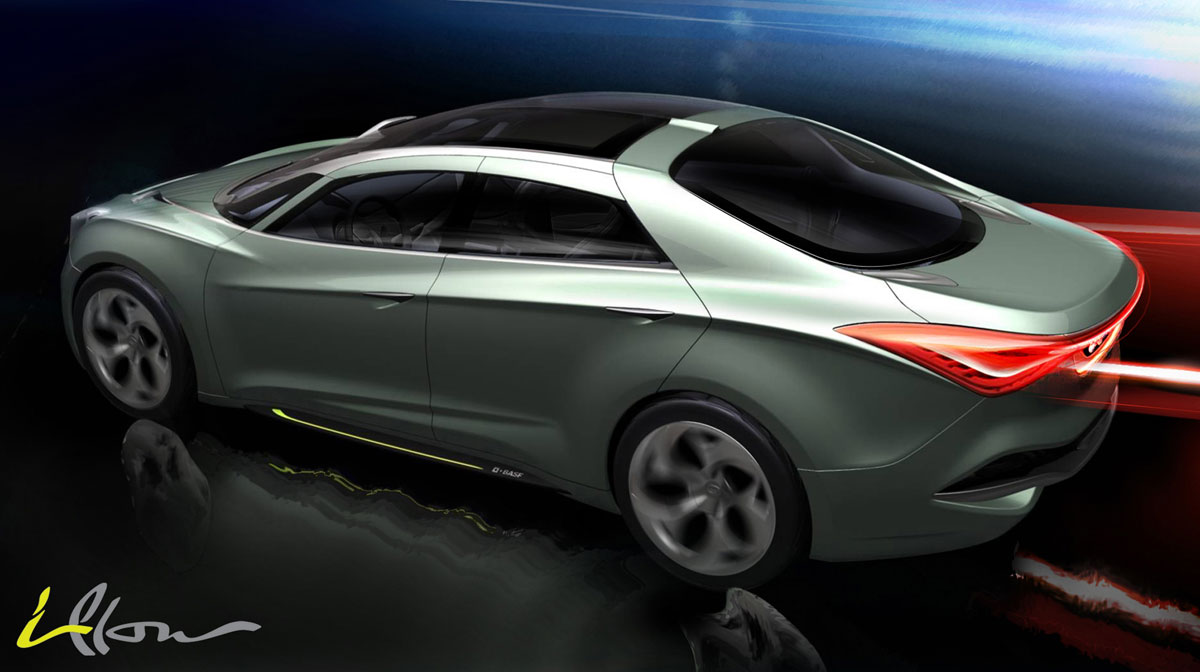
The Hyundai i-flow is one of the significant concept cars at Geneva, not just because it looks dramatic, but because under that heavily sculpted skin is a range of latest tech that could appear in Hyundai’s next generation of cars. Powering the i-flow is the company’s first diesel-electric hybrid powertrain consisting of a U2 1.7-litre oil burner with two-stage turbocharging and Hyundai’s lithium ion-polymer battery. Coupled to a six-speed, dual-clutch transmission, the drivetrain is capable of 33.3 km/l and a low CO2 output of 85g/km.


The i-flow is also a test bed for new energy harvesting ideas, ranging from a flexible solar panel roofing to a thermo-electric generator developed in partnership with leading chemical company BASF. One such idea is thermal engine encapsulation, which ensures that the engine reaches optimum operating temperature more quickly by retaining heat when the car is idle. Hyundai says that this translates into fuel savings and emissions cuts of 5% during summer and up to 9% in winter. The thermo-electric generator meanwhile recaptures energy from hot exhaust gases and converts it to electrical energy to help power auxiliary systems.


Designed at Hyundai’s European studio in Russelsheim, the i-flow sports the firm’s “fluidic sculpture” design language. With an overall length of 4,780 mm and a 2,800 mm wheelbase, the i-flow is a Honda Accord sized D-segment contender that is set to hit the market in 2011. It remains to be seen how much of the i-flow’s styling is retained for production, but things look promising with the recent Korean realisation that advanced design is as important as making competent cars.


Live pictures from Geneva and official images are after the jump!

Monday, February 15, 2010

Hyundai i-flow Concept to debut at Geneva 2010


Hyundai i-flow


The sketch above previews the Hyundai i-flow concept, which will make its world debut at the Geneva show at the end of this month. Hyundai says this concept will preview a future D-segment competitor – but really, is it time for a new D-segment competitor so soon when the Sonata has just been revealed? The Sonata already has a coupe-like roofline so it would be quite overkill for them to do a “Passat CC CC” with another take on a D-segment car.


This is just a hunch but it could be possible that what Hyundai meant in its press release as D-segment is different from what we normally consider as D-segment cars. In the US, what we call D-segment cars are CD-segment cars. The Camry is a CD car, while Toyota’s D car is the Avalon. Hyundai had a model like that – the Azera, and it was even sold here in Malaysia. The Azera was first launched in 2005 and it’s about time for a 5-year lifecycle full replacement model to arrive!


This new concept car could be slotted in between the Sonata and the Genesis as Hyundai’s most expensive front wheel drive executive car (taking the place of the Azera) before we start to enter Genesis rear wheel drive territory. But then again I could be wrong and this is really a “double CC” version of the Sonata.


The same press release also says this new i-flow concept will be used by chemical company BASF (there’s a good chance you use BASF products in your car everyday – they make petrol additives too) as a platform to showcase some technology such as lightweight materials, and solar cells.

New Hyundai Sonata and Tucson coming in April!


Hyundai Sime Darby will be a very busy company in 2010, and the first launches we can expect from them this year is the introduction of the new Sonata YF and Tucson SUV, which is scheduled for April. Both cars will be imported CBU from Korea, and our source has also revealed the variants that will be brought in.


The sixth-generation Sonata, codenamed YF, will come with two Theta II engines – a 163 bhp/198 Nm 2.0-litre and a 176 bhp/228 Nm 2.4-litre, mirroring the engine options of its D-segment Japanese rivals. Not only the Sonata’s figures compare very well with its competitors, it also has a six-speed automatic gearbox (Accord and Camry 2.4 have five forward ratios) which is self-developed and claimed to be “maintainence free”.


The Tucson SUV will also ship with these two engines and the six-speed auto ‘box. If you want 4WD, opt for the 2.4-litre model, as the 2.0-litre Tucson will be front-wheel drive only. Hyundai’s Theta II, which is a development of the GEMA world engine, is 10kg lighter than its predecessor, more frugal, cleaner and comes with Dual CVVT. The latest GDI direct injection engines won’t reach our shores however, due to below par fuel quality.


Spec levels for these two cars will be competitive and prices will undercut their immediate rivals, which we take as the Honda CR-V for the Tucson, Accord and Camry for the Sonata. You may have noticed the Arab number plates on these pictures; they were snapped this afternoon as we have been test driving the new Hyundais in Muscat, Oman. Unfortunately, we cannot share our impressions with you yet as the story is embargoed, but do stay tuned for updates as the launch date nears. Let’s just say for now that these new entries have great showroom appeal and are very decent to drive

Related Posts Plugin for WordPress, Blogger...